
While coaching a Receptive Tour Operator (RTO) client through a complete overhaul of her online product offerings, a recurring question emerged: How will the rise of AI search for travel impact the tourism experiences sold through B2B channels?
During those coaching sessions, a deeper anxiety surfaced. Relying strictly on B2B distribution means an operator’s exposure to end-consumers is limited by how travel trade clients showcase them. More importantly, what a Destination Management Company (DMC) or RTO excels at—serving as a hyper-local expert with the unique resources to stitch together seamless, memorable destination experiences—is increasingly hard for potential clients to discover online.
This shared industry challenge prompted this article. So many operators face the exact same dilemma: In the evolving AI search for travel landscape, is relying solely on traditional B2B distribution too restrictive, and how can tour packages remain discoverable?
Table of Contents
How AI Search for Travel Disruption Impacts B2B Operators
While humans feed data to Large Language Models (LLMs), AI is retraining traveller behaviour at a much faster pace.
In the past, travellers planning long-haul or complex trips searched online and consulted travel agents, friends, and family. The travel trade held a near-monopoly on destination expertise, deriving much of its value from bridging an information gap.
Today, before travellers ever reach a travel agent, they have already scanned online reviews, watched dozens of videos, and asked AI assistants for custom itinerary ideas. In some cases, the traveller arrives at the desk knowing micro-destination details better than the front-line sales agent.
The Problem with AI Itineraries Today
AI trip planners represent a massive disruption as search engines shift heavily toward AI-generated summaries (like Google’s AI Overviews).
However, if an AI assistant is asked to plan a complex “7-day Vancouver Island trip“, it often produces an itinerary covering vast geographic areas with an action-packed daily schedule that only an Ironman athlete could finish at first attempt. To a tourism product expert, watching AI try to organize complex local geography is entertaining.
While AI is not an experienced tour operator’s direct substitute yet, the speed of AI advancement means these models will soon close the factual gap.
A Warning from Fast-Moving Markets
That relief will be short-lived. If an operator’s role is merely providing a static product list, AI will quickly catch up.
Look at high-speed tourism markets like China, where AI adoption is widespread and traditional tour companies face massive restructuring.
Chinese Inbound Tourism to Canada Is Recovering: Are Canadian Businesses Ready? mentioned some of the rapid changes happening there.
According to Sohu News, in the first half of 2026 alone, over 2,400 tour companies lost their licence, with thousands more in transition. Travellers no longer rely on intermediaries for basic information, and price transparency from OTAs and service providers has eroded the appeal of generic, budget-focused packages。
Whether this is a harbinger for Western travel markets is open to interpretation, but it serves as a wake-up call: the rapid adoption of AI brings both significant risks to the traditional travel trade and massive opportunities for those who adapt.
The Rise of Agentic Search: Why Meta’s Muse Changes Everything
The shift in traveller behaviour is accelerating even faster than many expected. With Meta’s launch of Muse and its immediate adoption by commerce and travel heavyweights like Shopify and Expedia, we are witnessing the leap from generative AI (AI that answers questions) to agentic AI (AI that takes action).
Travellers will no longer use AI just for inspiration or surface-level ideas. Through agents like Muse, a user can simply say, “Find me a boutique 7-day slow-travel itinerary in British Columbia for a family of four, and book the best hotel stays and regional experiences,” and the AI will scan connected platform feeds, surface options, and execute direct bookings in seamless steps if authorized.
The results may not always be flawless, but convenience will prevail. Travellers will quickly adapt to this workflow, much like they grew accustomed to assistants like Siri and Gemini.
This AI search for travel trend monumentally changes how travellers source information:
- Bypassing Traditional Browsing: Travellers are being trained to skip multi-tab web browsing altogether. Inspiration, filtering, and transactions now happen in a single, conversational interface.
- Direct API & Feed Dependency: Platforms like Shopify and Expedia welcome these AI agents because their product inventories are structured so AI can read and sell them instantly.
- The B2B Vulnerability: If a Receptive Tour Operator or DMC’s products are hidden behind static PDFs or unindexed, unstructured B2B catalogues, they become completely invisible to agents like Muse.
For the travel trade, adapting to AI search for travel through Generative Engine Optimisation (GEO) and Answer Engine Optimisation (AEO) is no longer just a digital marketing exercise. It is the prerequisite for ensuring tour products can be seen, evaluated, and booked by the next generation of AI travel agents
Where the True Value of the Travel Trade Lies
AI can put together a basic, minimum-viable itinerary in seconds, but it cannot pick up on emotional hues, unstated needs, or complex real-time logistics.
The ultimate value of an RTO or DMC is never about offering the cheapest rate. It lies in four core strengths:
- Hyper-Local Knowledge: such as, knowing the exact spot and time for an unforgettable sunset, or accounting for local microclimates and transit quirks.
- Exclusive Resource Access: such as, securing limited-capacity bear-viewing spots in a wildlife lodge, high-demand national park shuttles, or authentic Indigenous cultural storytelling experiences.
- Anticipating Unspoken Needs: such as, reading between the lines of a client inquiry—like tailoring an adventurous itinerary to ensure toddlers are safely catered to.
- Curated Confidence: such as, creating holistic experiences that you stand behind because your team has personally vetted them on the ground. You are not a mere reseller of hotels and transfers; you are an experience creator.
The Practical Strategy: Getting Found in the AI Era
How can operators ensure AI models recognize that they offer the exact experiences travellers are looking for?
The key is reorganizing how tour descriptions are written so they directly answer the questions travellers and travel agents ask. Preparing for the future of AI search for travel isn’t about complex coding; it’s about organizing destination knowledge online so AI models understand what an operator does, where they excel, and how they solve complex travel logistics.
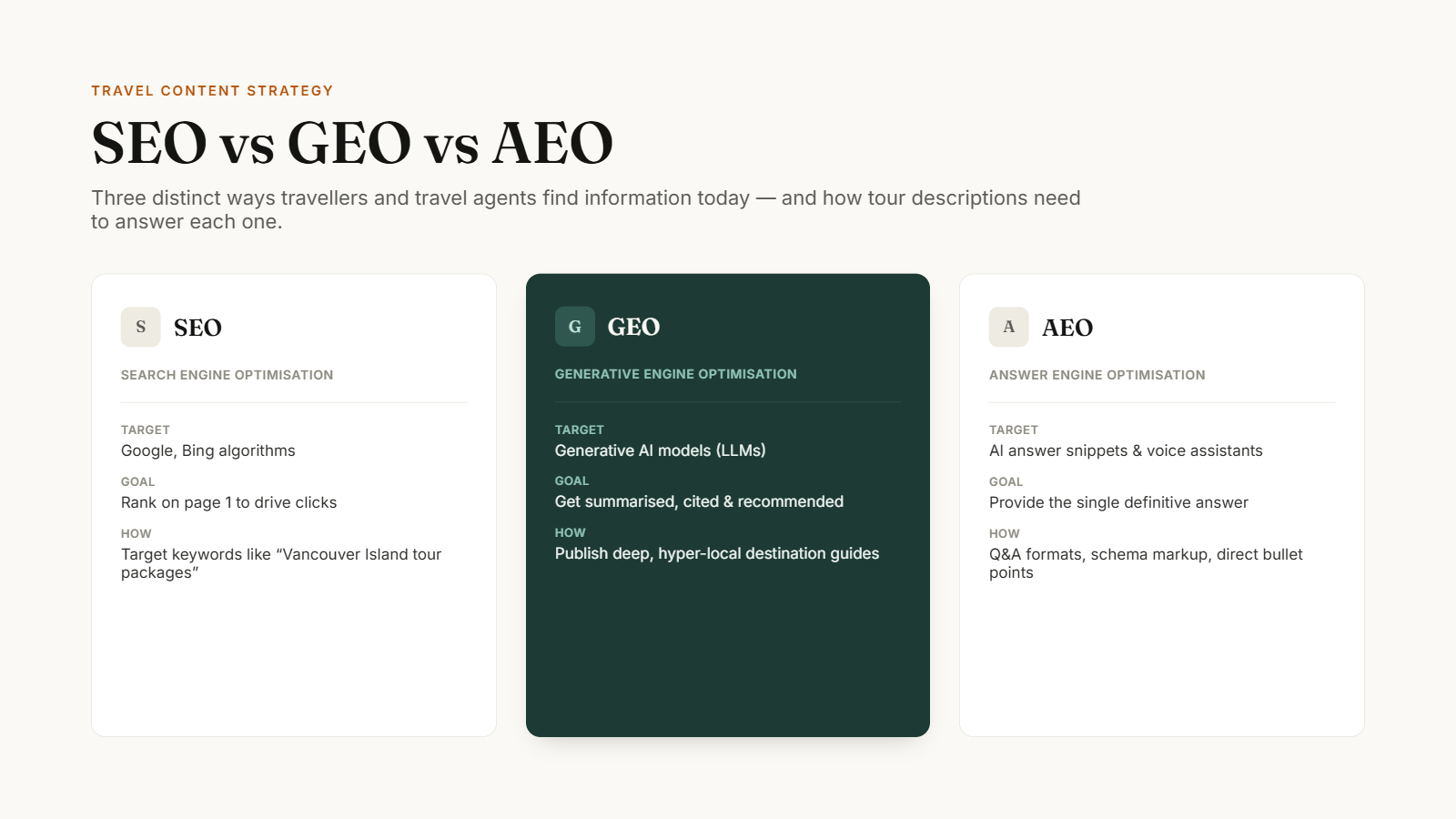
Think of it as optimizing for three distinct ways people find travel information today (this is an overly simplified table for the purpose of easier understanding)
| Framework | Primary Target | Goal | How it works |
|---|---|---|---|
| SEO (Search Engine Optimisation) | Traditional Search Algorithms (Google, Bing, etc.) | Rank links on page 1 to drive website clicks | Target keywords like “Vancouver Island tour packages” |
| GEO (Generative Engine Optimisation) | Generative AI Models (LLMs) | Get summarised, cited, and recommended in AI synthesis | Publish deep, contextual destination guides that prove hyper-local expertise |
| AEO (Answer Engine Optimisation) | AI Answer Snippets & Voice Assistants | Provide the definitive single answer to a specific query | Use explicit Q&A formats, Schema markup, and direct bullet points for instant facts |
While SEO helps people find an operator’s website address, AEO feeds AI exact, unassailable facts so it doesn’t invent impossible schedules. Meanwhile, GEO teaches AI why an operator’s curated local tours are the absolute best choice to recommend.
Here are four practical, non-technical steps any tour operator can take right now:
1. Write Like Answering a Client’s Phone Call
When travel agents or clients call an operator, they don’t ask in keywords. Instead, they ask full questions. AI searches work the exact same way.
- Ditch Generic Titles: Instead of titling a webpage section “Itinerary Overview”, use the exact question a traveller asks: “How do we explore Vancouver Island in 7 days without feeling rushed?”
- Give the Answer First: Place a clear, 2-sentence direct answer directly under the heading before diving into day-by-day details. AI models excel at extracting clean, direct answers.
2. Put Digital “Name Tags” on Products
When handing a printed catalogue to a travel trade partner, they instantly know what is a hotel, what is a transfer, and what is a 3-day tour package. AI engines need that same clarity on an operator’s website.
- Use Simple Website Helpers: No code writing is required. For websites on platforms like WordPress, popular plugins (like Rank Math, All-in-one SEO) or free resources (like Google’s Structured Data Helper) handle the technical execution.
- Label the Basics: These tools place hidden “digital labels” on web pages so AI instantly recognizes key details: This is a 5-day tour, it costs $X, it departs from Vancouver, and it’s suitable for families.
3. Share the Local Details AI Can’t Guess
AI models frequently make logistical mistakes—like planning daily drives that take twice as long as expected. Hyper-local knowledge is an operator’s strongest weapon against AI “hallucinations.”
- Publish Real Logistics: Include the essential details generic AI scrapers miss, such as seasonal ferry reservation windows, walking difficulty breakdowns, or local weather tips.
- Build Digital Co-Citation & Trade Presence: AI engines establish authority by cross-referencing information across the travel ecosystem. Appearing in official DMO business directories, regional partner portals, social media channels, travel media coverage, and consistent distribution partner listings signals to AI models that a brand is a vetted, trusted destination expert.
4. Optimize for “Zero-Click” Visibility and Direct Brand Trust
With Google AI Overviews and chat assistants providing direct summaries, many travellers now find answers without clicking through to individual websites.
- Claim the Source Citation: When AI extracts structured facts into an AI Overview panel, the operator earns the official citation link underneath the answer.
- Build Direct Brand Trust: Even if end-consumers do not click through immediately, consistent citations across AI queries build strong brand familiarity. Over time, this prompts travellers and retail agents to specifically search for or request the operator’s products by name.
Can You Build an “AI Citation Moat”? What the Debate Means for Tourism
There is an ongoing debate among digital marketing and GEO experts around the concept of an AI Citation Moat—the theory that acting early to structure tour products for AI search creates a lasting, defensible competitive advantage.
Proponents argue that when generative search engines repeatedly cite an operator’s local logistics, unique itineraries, and destination insights, that brand becomes embedded in the AI’s trusted training data network. Over time, this could create a compounding effect: the more AI models rely on an operator’s expertise, the harder it becomes for competitors to displace them in AI-generated travel recommendations.
While critics correctly point out that an AI citation moat is far from unbreakable because AI models update constantly, and algorithms shift rapidly, the potential upside remains significant. Getting ahead of the curve today gives B2B operators a valuable first-mover advantage while competitors are still relying on static PDF brochures.
Turning AI into an Advantage
For operators taking the time to reimagine their tour offerings, the timing couldn’t be better. AI tools can also be leveraged internally to analyze target audience profiles, evaluate competitor offerings, and audit website content.
By letting AI handle repetitive analytical tasks, operators can free up energy to focus on what humans do best: crafting unforgettable, hyper-local travel experiences that both AI engines and real travellers will trust and recommend.
Navigating the shift to AI search is not about abandoning traditional B2B relationships; it is about ensuring that an operator’s hard-earned destination expertise remains visible and valued in a changing digital ecosystem.
While the technology and search frameworks will continue to evolve, one constant remains: algorithms cannot replicate true local authority, trusted trade relationships, or real-world experience creation.
By taking proactive steps to structure product knowledge today, tourism businesses can safeguard their relevance, reach next-generation travel agents, and turn the rise of AI into a powerful driver of long-term growth.
(Disclaimer: The feature image was created by using Claude AI from the content of this post.)
About the Author
Leona Zheng is the founder of Meridian Span Strategic Advisors and a tourism consultant with 28 years of experience in British Columbia’s tourism industry. She specializes in travel trade development, international market readiness, tourism products strategy, and Chinese digital marketing. She supports tourism operators and destination organizations in expanding global market reach, strengthening travel trade partnerships, and improving competitiveness through practical, hands-on consulting.
- Reimagining B2B Travel Products for the AI Search Era: Why GEO is Your New Survival Kit
- Chinese Inbound Tourism to Canada Is Recovering: Are Canadian Businesses Ready?
- Bus Tours: Tourism Opportunity or Destination Challenge?
- Fishing Highway and the Land of Hidden Waters — Why an Arts, Artisan & Local Products Discovery Map Would Be a Wonderful Addition
- Beating the Trade Show Matchmaking Algorithm—For Your Future Rendezvous Canada